
What if the greatest barrier to your best ideas isn’t a lack of inspiration, but the very tool you’re using to capture them? Most of us struggle with an inner critic that wakes up the moment we see a blinking cursor. We worry about where our private thoughts are stored or get distracted by complex interfaces that feel more like work than a release. Finding a dedicated stream of consciousness writing app should feel like stepping into a quiet room, not managing a complex database.
It’s true that the modern digital world often feels loud and demanding. You deserve a space where you can capture raw ideas before they vanish, without the fatigue of logins or the anxiety of cloud syncing. We’re going to show you how to reclaim your mental lightness and achieve a genuine flow state. This article explores how a digital sanctuary can bypass self-censorship and help you capture uninhibited thoughts. You’ll discover how the right minimalist tools, like a browser-based quick notes canvas, can act as a mindful companion for your most authentic creative expression.
Key Takeaways
- Learn how to silence your inner critic by embracing a continuous, unedited flow of thoughts to capture fleeting ideas before they fade.
- Discover why removing barriers like registration and cloud storage is essential for achieving a true state of mental clarity and uninhibited expression.
- Explore how using a dedicated stream of consciousness writing app with integrated voice-to-text can help you bypass the physical limits of typing to capture raw emotion.
- Master the art of the mindful writing ritual by curating a distraction-free digital environment that prioritizes your peace of mind.
- Understand the restorative power of local-only processing, ensuring your most private reflections remain securely within your own browser sanctuary.
What is a Stream of Consciousness Writing App?
At its core, stream of consciousness writing is the practice of capturing the continuous, unedited flow of your internal dialogue. It mirrors the psychological concept of the stream of consciousness, where thoughts are viewed as a fluid, ever-changing sequence rather than a structured list. While traditional journaling often involves reflection, this technique is about the immediate “now.” It’s the act of letting your words tumble onto the page without the interference of your inner editor or the fear of a permanent record.
A dedicated stream of consciousness writing app serves as a digital sanctuary for these rapid-fire ideas. Unlike a standard word processor designed for formatting and final drafts, these tools act as a “thought capturer.” They prioritize speed and mental lightness over features like font choices or margin settings. For the mind to feel truly safe to wander, the interface must almost vanish. This invisibility allows you to focus entirely on the rhythm of your own breath and the movement of your ideas, creating a space where raw honesty can finally emerge.
From Pen and Paper to Digital Fluidity
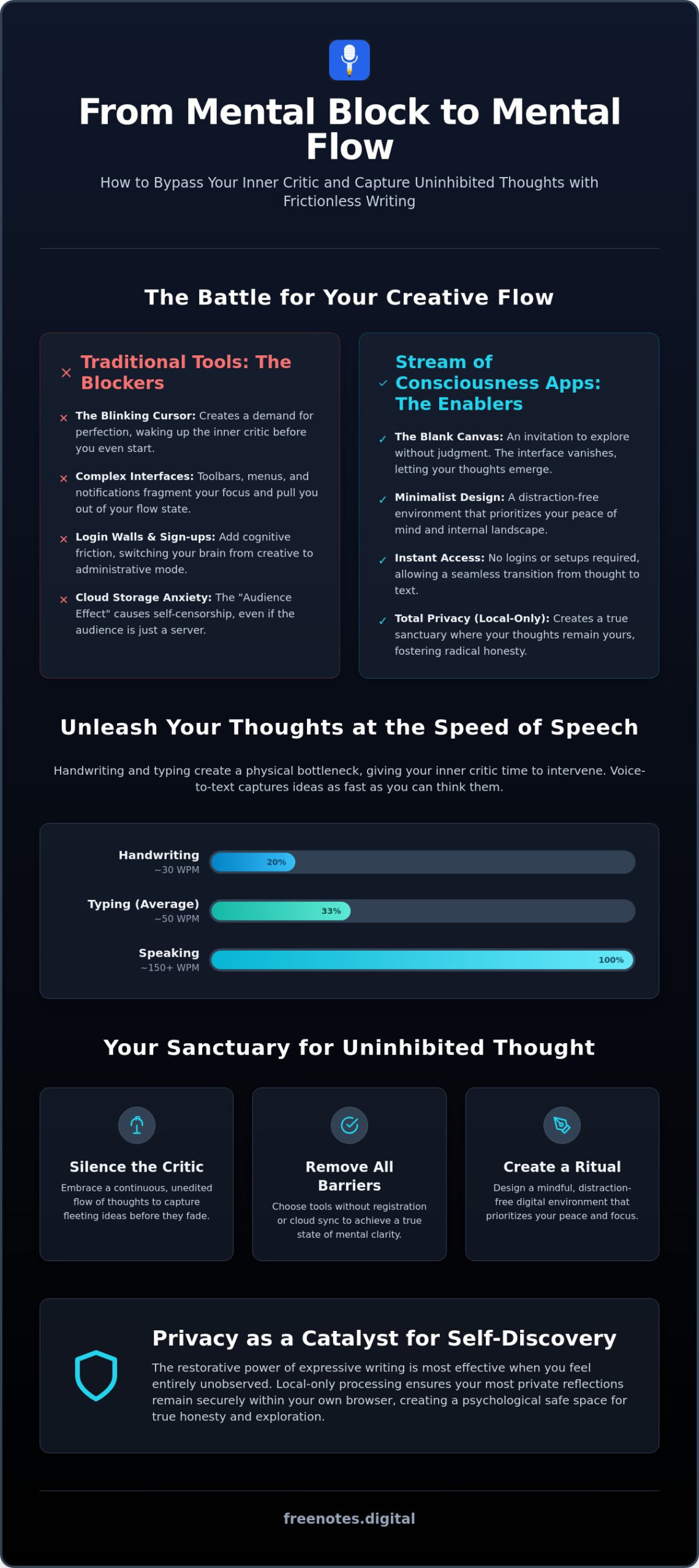
While many traditionalists argue for the tactile feel of paper, handwriting often creates a physical bottleneck for fast thinkers. Most people can only write by hand at a fraction of the speed they can think or type. This delay gives the inner critic enough time to intervene and sanitize your thoughts. Modern digital tools, such as a Quick Notes Canvas, offer a clean slate that matches the pace of your mind. They allow for non-linear brain dumps that feel more like a conversation with yourself than a school assignment. This evolution toward digital fluidity ensures that your most fleeting insights don’t evaporate before you can record them.
Why Traditional Apps Block Your Creative Flow
Standard office suites are often the enemies of uninhibited expression. The blinking cursor in a complex program like Word can feel like a demand for perfection rather than an invitation to explore. Toolbars, notifications, and complex menus fragment your mental space and pull you away from your internal landscape. These distractions create a subtle friction that tells your brain it’s time to perform rather than simply be. A stream of consciousness writing app is a frictionless mirror for the mind. By choosing a tool like a Free Voice to Text Note Taking Tool, you remove the mechanical barriers of typing and the visual clutter of traditional software, allowing your most private reflections to flow without hesitation.
The Psychology of Frictionless Writing and Mental Clarity
Every step between a thought and its capture is a potential point of failure. When you feel a surge of inspiration, the last thing you need is a registration form or a password prompt. This “registration barrier” creates immediate cognitive load, forcing your brain to switch from a creative mode to a logical, administrative one. By choosing a no-login text editor, you eliminate this friction entirely. It allows you to move from awareness to expression in a single, fluid motion, preserving the raw energy of your ideas before they are filtered by the conscious mind.
The “Audience Effect” is another significant psychological hurdle. It’s the tendency to change our behavior when we believe we are being watched. In the digital age, cloud storage can act as a silent observer. Even if no human ever sees your notes, the knowledge that your data resides on a remote server can lead to subtle self-censorship. You might find yourself polishing sentences or avoiding certain topics. However, research into expressive writing indicates that the restorative power of journaling is most effective when you feel entirely unobserved. A stream of consciousness writing app that prioritizes local storage restores this sense of sanctuary, fostering a level of radical honesty that is rarely found in traditional suites.
Achieving a true flow state is a delicate process. Scientists have noted that even a 10-second interruption, such as a “save” notification or a sync error, can derail your concentration and require several minutes of effort to regain. Consistency is key to mental lightness. A stream of consciousness writing app should function as a quiet, reliable assistant that stays out of the way. It should provide a steady rhythm that allows your prose to unfold at a pace that feels natural and restorative, rather than frantic or rushed.
Privacy as a Catalyst for Self-Discovery
Local-only processing creates a psychological safe space that is essential for deep reflection. When your words are processed within your own browser and never sent to a server, you gain a unique form of digital anonymity. This freedom allows for uninhibited thoughts to surface, providing a clear path to self-discovery. It transforms your device into a private garden where you can plant ideas without the fear of them being harvested or analyzed by external algorithms. For those seeking to deepen this sense of security, choosing a note taking app that doesn’t sync is a vital step toward reclaiming your personal sovereignty and ensuring your most intimate reflections remain entirely your own.
Achieving Browser Serenity
There is a profound restorative power in a minimalist online text canvas. It offers a “clean slate” that counters the digital fatigue caused by complex, toolbar-heavy interfaces. By choosing from the best minimalist writing app online options, you can curate an environment that respects your personal space and creative process. If you find your mind becoming cluttered, starting a fresh session on a Quick Notes Canvas can provide the immediate relief and focus you need to clear mental overwhelm.
Voice-to-Text: The Ultimate Hack for Stream of Consciousness
While many think of a stream of consciousness writing app as a place for typing, your voice is often the most direct path to your subconscious. Speaking is primal. It’s the first way we learn to externalize our inner world, and it carries an intimacy that the mechanical clatter of keys can’t always match. Dictation allows you to capture the raw emotion and subtle inflections of your thoughts, turning a simple session into a profound act of self-witnessing. By using free voice to text online, you create a bridge between the abstract feeling in your chest and the concrete word on the screen.
This method is particularly effective for overcoming “blank page syndrome.” When the cursor feels like an interrogator, speaking into a digital sanctuary removes the pressure of the visual. Understanding the neuroscience of writing reveals that the act of expressing our narrative, whether through hands or voice, helps regulate our emotional state. It frees up cognitive resources that were previously spent on rumination. Vocalizing your stream of consciousness forces a continuous forward motion, making it nearly impossible for your internal editor to stop and fix a “mistake” before the thought is complete.
Bypassing the Inner Critic
The average person speaks at about 150 words per minute, while typing speeds often hover between 40 and 80. This gap is where your inner critic lives. When you type, your brain has time to doubt, delete, and rephrase. When you speak, you outrun that hesitation. To deepen this focus, try closing your eyes while you dictate. This simple shift in perspective removes external distractions and lets you sink deeper into your internal landscape. It transforms the experience from a productivity task into a restorative ritual of mental lightness.
Transitioning from Sound to Structured Thought
Once your “brain dump” is captured, the transition to clarity becomes much smoother. You’re no longer staring at a void; you’re looking at a raw map of your mind. Using voice notes in browser no login ensures that this transition happens without the friction of account setups or cloud anxiety. For those who want to take this a step further, exploring voice notes without account requirements can provide an even more seamless path from spoken thought to captured insight. You can treat the resulting text as a digital scratchpad, refining the gems you’ve unearthed during your session. Ultimately, voice-to-text transforms transient insights into permanent clarity.
How to Design Your Mindful Writing Ritual
A tool is only as effective as the environment you create around it. Before you open your stream of consciousness writing app, take a moment to curate your physical and digital space. Silence your phone and close any unnecessary browser tabs. This simple act tells your brain that for the next few minutes, there are no demands on your attention. By reducing external noise, you allow your internal voice to become clearer, making it easier to slip into a state of focused tranquility.
Choosing your mode of expression is the next step in this ritual. Some days, the rhythmic click of a keyboard provides a grounding sensation that helps you organize chaotic thoughts. On other days, your mind might feel too fast for your fingers. This is when a Free Voice to Text Note Taking Tool becomes invaluable. It allows you to speak your truth without the physical bottleneck of typing, ensuring that your most fleeting insights are captured with ease. Listen to your energy levels before you begin; there’s no right way, only the way that feels most restorative in the moment.
The “Five-Minute Clear” is a powerful daily practice for achieving mental lightness. Set a timer and commit to writing or speaking without pause until it rings. Don’t worry about grammar, punctuation, or making sense. The goal isn’t to produce a masterpiece; it’s to vent the pressure of your accumulated thoughts. Once the timer ends, you have a choice. You can save the session if you’ve unearthed a “golden nugget” of an idea, or you can simply close the window. There is a profound sense of closure in letting go of thoughts that no longer serve you.
Creating a Digital Sanctuary
Spontaneity is the lifeblood of creative flow. This is why a no-account tool is essential. The moment you have to remember a password, your flow is broken. A minimalist UI, like the one found in a Quick Notes Canvas, ensures that your focus remains on your words rather than on complex settings. This digital scratchpad acts as a quiet, reliable assistant, staying out of the way until the exact moment you need to capture a non-linear brain dump or a sudden spark of inspiration. It provides a sense of reliable, unobtrusive support that respects your creative process.
Post-Writing Reflection
How you end your session is just as important as how you start. If you’ve captured something meaningful, export it to your permanent notes system to avoid cloud clutter. However, if the session was purely for emotional release, embrace the ritual of “Clearing the Canvas.” This act of digital housekeeping mirrors the mental reset you’ve just achieved. It leaves you feeling lighter and ready to move forward with a sense of calm confidence. Understand that the value of the ritual is in the process, not the product.
Free Notes App: A Sanctuary for Uninhibited Thought
Free Notes App is designed to be more than just a utility; it’s a dedicated sanctuary for mental stillness. In a digital landscape where most software demands your data and your attention, we offer a clean slate that asks for neither. By serving as a purposeful stream of consciousness writing app, the platform allows you to move directly from a state of overwhelm to one of clarity. There are no accounts to manage and no complex settings to navigate. You simply arrive, express yourself, and leave feeling lighter.
Your most private reflections deserve a space where they aren’t just encrypted, but entirely local. Our local-only processing ensures that every word you type or speak stays within the confines of your own browser. This technical choice is a core part of our philosophy. It eliminates the “Audience Effect” discussed earlier, giving you the psychological safety to explore your deepest thoughts without the lingering worry of cloud storage or server-side logs. When you know your data never leaves your device, you’re free to be your most authentic self.
The seamless combination of a minimalist Quick Notes Canvas and an integrated Free Voice to Text Note Taking Tool creates a versatile environment for any mood. Whether you need the grounding rhythm of typing or the uninhibited speed of speech, the interface adapts to your needs. This flexibility is essential for sustaining a flow state. It removes the mechanical friction that often halts creative momentum, ensuring that your stream of consciousness writing app remains a mindful companion in your daily life.
A Tool That Stays Out of Your Way
The elegance of a browser-based tool lies in its immediate accessibility. There are no heavy downloads to wait for and no updates to manage. Free Notes App acts as a quiet, reliable assistant that is ready the moment an idea strikes. This zero-data footprint offers a unique form of psychological relief. You can use the app as a temporary scratchpad for transient thoughts, knowing that once you close the tab, your mental clutter has been safely externalized. This leaves your mind refreshed and the slate clean for your next session.
Start Your Flow Today
Experience the restorative power of frictionless writing for yourself. Reclaim your mental space and unlock the creative flow that is often buried under daily stress. Whether you’re conducting a “Five-Minute Clear” or capturing a complex non-linear brainstorm, the right environment makes all the difference. It’s time to bypass your inner critic and embrace a digital sanctuary designed for uninhibited expression. Begin your stream of consciousness session on Free Notes App and discover the tranquility of a truly private writing experience.
Step Into a Lighter Mental Space
True mental clarity begins when you remove the barriers between your thoughts and the page. We’ve seen how a minimalist approach, combined with the intimacy of voice-to-text, can bypass your inner critic and foster radical honesty. By choosing tools that prioritize your privacy and focus, you transform writing from a chore into a restorative daily ritual. It’s about creating a digital sanctuary where you can breathe, reflect, and simply be without the weight of digital clutter.
Choosing the right stream of consciousness writing app is the final piece of the puzzle. You deserve a platform that offers instant browser-based idea capture without the fatigue of registration or the worry of data tracking. With local-only processing for total privacy and no login required, you can finally focus on the rhythm of your own mind. Experience mindless flow on Free Notes App and see how effortless self-discovery can be. Your most authentic ideas are ready to surface; let them flow freely and without hesitation.
Frequently Asked Questions
What is the difference between journaling and stream of consciousness writing?
Journaling often involves reflective storytelling or recording specific life events, whereas stream of consciousness writing focuses on the immediate, unfiltered flow of your internal dialogue. It’s a practice of capturing thoughts exactly as they arise without pausing for grammar, structure, or logic. This technique prioritizes the raw movement of the mind over a polished narrative. It serves as a restorative mental release rather than a historical record of your day.
Is it better to type or use voice-to-text for stream of consciousness?
Choosing between typing and vocalizing depends on your personal pace and the current volume of your thoughts. Many find that a Free Voice to Text Note Taking Tool is the most effective way to outrun the inner critic because we naturally speak faster than we can type. Typing can offer a grounding, tactile experience, while speaking allows for a more intimate and emotive release of transient ideas without physical bottlenecks.
How do I keep my stream of consciousness notes private?
You can maintain total privacy by using a stream of consciousness writing app that utilizes local-only processing. This means your reflections are handled entirely within your browser and are never transmitted to a remote server. To ensure your thoughts remain yours alone, look for platforms that don’t require accounts or cloud syncing. Transitioning to a note taking app that doesn’t sync is one of the most effective ways to create a digital sanctuary where your most private ideas are protected from any external observation or data harvesting.
Do I need to be a ‘good’ writer to use a stream of consciousness app?
You don’t need any writing experience or technical skill to benefit from this practice. The goal is mental clarity and emotional release rather than the production of a literary work. Because no one else will ever see these notes, you’re free to be as messy, repetitive, or incoherent as you need to be. It’s a quiet, reliable assistant for your self-discovery process, not an assignment for an audience.
Why should I use a no-registration tool for writing?
No-registration tools protect your creative flow by removing the cognitive load of managing passwords and account setups. When you don’t have to log in, you can move from a spark of inspiration to expression in seconds. This lack of a digital paper trail also enhances your sense of security, allowing you to be more honest in your writing. It’s the digital equivalent of a fresh, anonymous scratchpad that stays out of your way.
How does local-only storage work in my browser?
Local-only storage works by saving your text in your browser’s temporary memory rather than on a company’s server. When you use a Quick Notes Canvas, your data exists only on your specific device. This means that once you close the tab or clear your cache, the information is gone forever unless you choose to export it. It ensures that your most private thoughts leave a zero-data footprint, respecting your personal space entirely.
What should I do with my notes after a stream of consciousness session?
You should review your notes for any useful insights and then decide whether to keep them or let them go. If a thought feels worth preserving, export it to a permanent home on your own device. If the session was purely for emotional venting, there is a profound restorative power in clearing the canvas. This act of digital housekeeping provides a sense of closure and mental lightness, leaving you refreshed for the day ahead.
Can stream of consciousness writing help with anxiety?
This practice is a powerful tool for reducing anxiety because it externalizes the repetitive thoughts that cause mental overwhelm. By moving stressors from your mind onto a digital canvas, you gain immediate perspective and a sense of calm control. This process of expressive writing helps regulate emotions and frees up cognitive resources that were previously spent on rumination. It allows you to achieve a state of tranquility and mental lightness.